
What Urban Security Teams Need From Cloud VMS





As urban security operations become more distributed, data-heavy, and compliance-sensitive, the question is no longer whether teams should use a cloud video management system, but what kind of cloud VMS is fit for mission-critical work. For smart cities, transport hubs, campuses, utilities, and other critical infrastructure environments, the right platform must do far more than host video. It needs to support fast incident response, multi-site visibility, cyber resilience, privacy controls, open integration, and long-term operational scalability. In practice, urban security teams need a cloud VMS that reduces blind spots without creating new governance or performance risks.
For buyers and operators alike, the real decision point is this: can the platform connect cameras, AI analytics, access control, thermal and infrared sensors, and digital workflows into one manageable security environment while still meeting standards, uptime, and data-governance requirements? That is what separates consumer-grade cloud video from enterprise-ready cloud VMS for modern urban security.
What urban security teams actually need from cloud VMS
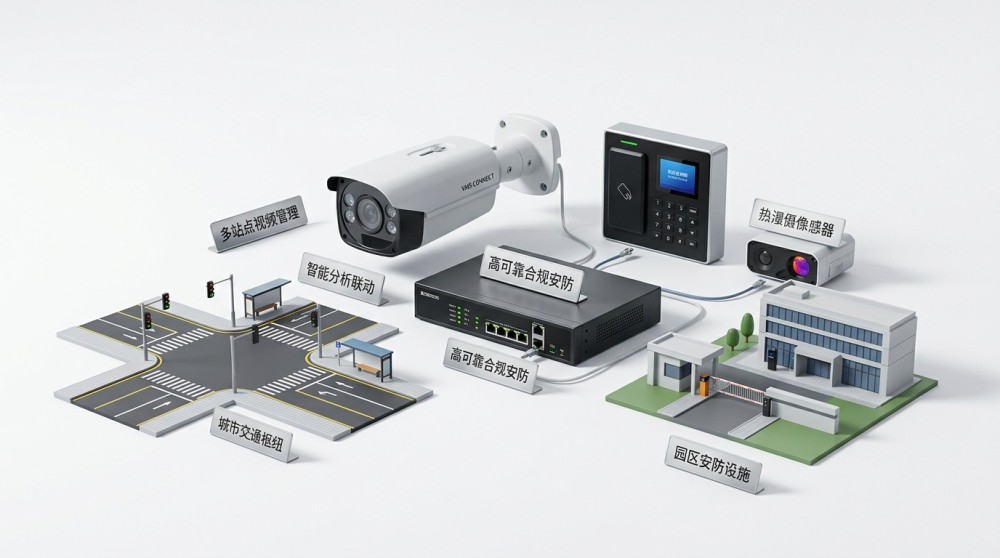
Search intent behind this topic is highly practical. Most readers are not looking for a basic definition of cloud VMS; they want to understand what capabilities matter when protecting dense, dynamic, high-risk urban spaces. They are typically evaluating platforms, writing specifications, planning upgrades, or checking whether a current system can support future operational demands.
For these audiences, the most important needs usually fall into six areas:
- Reliable live and recorded video access across multiple sites without excessive latency or administrative overhead
- Cybersecurity and data governance that align with enterprise and public-sector requirements
- Support for AI-enabled workflows such as object classification, perimeter alerts, crowd monitoring, and anomaly detection
- Integration with access control, building systems, GIS, and digital twin platforms
- Operational resilience during network instability, outages, or large-scale incidents
- Scalability and cost control across expanding camera counts, storage retention policies, and mixed sensor environments
In other words, urban security teams need a cloud VMS that improves command visibility and decision speed without compromising compliance, interoperability, or operational continuity.
Why basic video hosting is not enough in smart city and critical infrastructure environments
In urban and industrial settings, security teams rarely manage video in isolation. They manage incidents, public safety workflows, contractor movement, perimeter events, transportation bottlenecks, after-hours alarms, and evidence requests. A cloud VMS must therefore function as an operational platform, not just a storage destination.
That is especially important in environments such as:
- Airports, rail, and metro systems
- Municipal surveillance programs
- Utility and energy facilities
- Large campuses and commercial districts
- Ports, logistics centers, and industrial parks
- Hospitals, public venues, and mixed-use developments
These environments generate high video volumes, multiple user roles, and overlapping compliance obligations. A weak cloud VMS may appear attractive on price or simplicity, but can create major downstream issues: fragmented investigations, limited forensic search, vendor lock-in, poor device compatibility, and inconsistent auditability.
For enterprise decision-makers, the main lesson is clear: if the platform cannot support city-scale operations, policy enforcement, and cross-system response workflows, it will not deliver strategic value even if it stores video successfully.
Core cloud VMS capabilities that matter most for urban security operations
When evaluating solutions, teams should prioritize capabilities that directly affect incident response, governance, and lifecycle performance.
1. Multi-site command visibility
Urban security operations often span hundreds or thousands of endpoints across dispersed facilities. A capable cloud VMS should provide a unified operational view across districts, buildings, transit nodes, and remote infrastructure. Operators should be able to move from global overview to camera-level detail quickly, with role-based permissions controlling access by region, site, or function.
2. Edge-to-cloud architecture
Purely centralized designs are not always suitable for mission-critical environments. Teams need edge recording, local failover, bandwidth optimization, and event-based synchronization to the cloud. This is particularly important where uplink quality varies or where uninterrupted recording is essential.
3. Low-friction incident investigation
Fast search tools are essential. Operators should be able to find footage by time, camera, event, metadata, alarm source, or analytics tag. The more time an operator spends navigating storage structures, the less effective the system becomes during an active incident.
4. Open integration framework
Urban security rarely depends on cameras alone. A modern cloud VMS should integrate with access control, intrusion systems, intercom, radar, thermal imaging, building management, dispatch tools, and third-party AI engines. Support for open standards such as ONVIF is highly valuable, especially in mixed-vendor environments.
5. Audit trails and chain-of-custody support
For public safety, regulatory review, or internal investigations, teams need clear logs showing who accessed video, what was exported, and whether footage integrity was preserved. This is not a niche requirement; it is foundational for enterprise governance.
6. Usable operator experience
Even the most advanced platform can fail operationally if operators find it slow or difficult to use. Interface design, map-based navigation, alarm prioritization, mobile access, and workflow automation all affect real-world response quality.
Data governance, privacy, and security standards are now decision-critical
One of the biggest concerns around cloud VMS in urban environments is not functionality but control. Security leaders, project managers, and compliance teams need to know where data is stored, how it is encrypted, who can access it, and whether retention policies can be enforced consistently across jurisdictions.
Key governance questions include:
- Does the platform support encryption in transit and at rest?
- Can administrators apply granular retention rules by site, camera, or event type?
- Are access rights role-based, auditable, and easy to review?
- Can the system support privacy masking, redaction, and compliant video sharing?
- Does the vendor align with relevant frameworks such as GDPR, NDAA-sensitive procurement policies, and internal cyber standards?
- Is there a clear data residency model for public-sector or regulated deployments?
For quality-control and security management personnel, these points often matter as much as image quality. A cloud VMS that introduces uncertainty around privacy or evidence handling can increase legal and operational risk, even if its features appear advanced.
This is why enterprise buyers increasingly treat cloud VMS as part of broader data governance strategy. The platform should fit not only surveillance objectives, but also institutional policy, procurement scrutiny, and long-term compliance obligations.
How cloud VMS should support AI vision, thermal sensing, and space intelligence
In modern urban security, video is no longer just a record of past events. It is an input for real-time decision-making. That means cloud VMS should be able to work with AI vision, metadata-rich analytics, and non-visible spectrum sensors such as thermal and infrared devices.
For example, security teams may need to:
- Detect perimeter intrusion in low-light or no-light conditions
- Monitor crowd density or unusual movement patterns
- Validate alarms from access points or restricted zones
- Correlate thermal alerts with visible-spectrum video
- Track objects or incidents across multiple camera views
A strong cloud VMS should not treat these as isolated add-ons. It should support synchronized event timelines, metadata ingestion, rules-based automation, and workflows that help operators verify alerts quickly. This is especially useful in critical infrastructure and large public environments where false alarms are costly and delayed response can escalate risk.
For organizations investing in digital twin initiatives or spatial intelligence platforms, cloud VMS should also support contextual visualization. Camera streams, alarm events, and sensor data should be mappable into building, campus, or city-level models, allowing teams to understand incidents spatially rather than through disconnected dashboards.
Questions buyers should ask before selecting a cloud VMS
To make a sound decision, buyers should move beyond feature lists and test whether a platform fits their operational model. The following questions are especially useful during vendor evaluation:
- Can the platform scale from current deployment size to future city-wide or multi-campus requirements?
- How does it perform under constrained bandwidth or during WAN disruption?
- What integrations are native, and what requires custom development?
- How are firmware, cybersecurity patches, and device health managed?
- Can existing cameras and sensors be retained, or is hardware replacement required?
- What evidence export, redaction, and audit capabilities are available?
- How does pricing change with storage retention, analytics, and user count?
- What service-level commitments exist for uptime, support, and incident response?
- Does the system support open architecture or create long-term vendor dependency?
For project managers and engineering leads, pilot testing is critical. A short proof of concept should include real network conditions, live alarm workflows, operator usage, and integration with at least one adjacent system such as access control or building management. This reveals practical issues that product demos often hide.
Common mistakes urban security teams should avoid
Many cloud VMS projects underperform not because cloud is the wrong model, but because procurement focuses too narrowly on headline features.
Common mistakes include:
- Buying for storage first, operations second: retention matters, but response workflows matter more
- Ignoring integration depth: “compatible” is not the same as operationally unified
- Underestimating data governance: privacy, residency, and auditability should be evaluated early
- Overlooking edge resilience: urban networks are not always stable enough for cloud-only assumptions
- Failing to involve end users: operators often expose usability issues that decision-makers do not see in presentations
- Accepting closed ecosystems too quickly: short-term simplicity can create long-term cost and flexibility problems
The best-performing deployments usually come from cross-functional evaluation involving security operations, IT, compliance, facilities, and procurement. Cloud VMS sits at the intersection of all of them.
Final takeaway: the best cloud VMS is the one that strengthens operations and governance together
What urban security teams need from cloud VMS is ultimately straightforward: dependable visibility, faster investigations, stronger integration, and tighter control over risk. But delivering that in smart city and critical infrastructure environments requires more than cloud convenience. It requires enterprise-grade architecture, open interoperability, robust cybersecurity, and policy-aligned data governance.
If a cloud VMS can unify video, AI analytics, thermal and infrared sensing, access events, and spatial intelligence into one operational layer, it becomes a force multiplier for security teams. If it cannot, it remains just another video repository.
For organizations planning their next upgrade, the right evaluation lens is not “Does this system support cloud?” but “Can this cloud VMS support our operational complexity, compliance burden, and future growth?” That is the question that leads to better outcomes, better resilience, and better long-term security value.
Related News
Thermal Sensing
Curation by industry experts
Popular Tags
Related Industries
- Which chemicals market updates matter for refrigerant procurement budgets?Chemicals market updates reveal the refrigerant supply, regulatory, and pricing risks that shape smarter procurement budgets and resilient critical infrastructure.
- How GDPR shapes biometric access control deployments in EuropeBiometric access control Europe: learn how GDPR affects lawful basis, DPIAs, secure architecture, retention, vendor contracts, and inclusive deployment planning.
- When edge AI analytics can reduce cloud video processing costsEdge AI analytics can cut cloud video processing costs by filtering events locally, reducing bandwidth, storage, and inference demand. Explore a smarter hybrid surveillance strategy.
Weekly Insights
Stay ahead with our curated technology reports delivered every Monday.