
When Is Infrared Imaging Better Than Visible-Light Cameras?





When Is Infrared Imaging Better Than Visible-Light Cameras?
When is infrared imaging better than visible-light cameras? Usually, when the task is to detect a person, object, or abnormal heat pattern and visible illumination is unreliable. Thermal cameras can operate in complete darkness, making them useful for perimeter surveillance, industrial monitoring, and nighttime situational awareness. Visible-light cameras remain stronger for color, readable text, facial detail, and visual evidence.
The choice is not simply “night versus day.” A dark warehouse entrance, a sun-heated rail yard, and an electrical cabinet present different sensing problems. Reliable selection starts with the event that must be detected, the conditions surrounding it, and what an operator needs to know afterward.
Infrared night vision and thermal imaging are different technologies
“Infrared camera” is an ambiguous purchasing term. Many security cameras use near-infrared illumination: an emitter lights the scene with wavelengths people cannot normally see, and the camera records reflected light. This produces a monochrome image that can retain useful visual detail, but performance still depends on illumination, reflectivity, exposure, and distance.
Thermal imaging instead detects infrared radiation emitted by surfaces. Common systems operate in long-wave infrared; some specialized systems use mid-wave infrared. They do not need visible light or an infrared floodlight to form an image. Their advantage comes from differences in apparent thermal radiation between a target and its surroundings.
That distinction matters in a tender. A requirement for “infrared nighttime detection” could be satisfied by very different equipment unless the sensing method is specified. Also, a thermal surveillance camera is not automatically a temperature-measurement instrument. Quantitative monitoring requires a suitable radiometric model, appropriate calibration, and correct measurement settings.
Where thermal imaging has a practical advantage
Unlit perimeters and inconsistent lighting
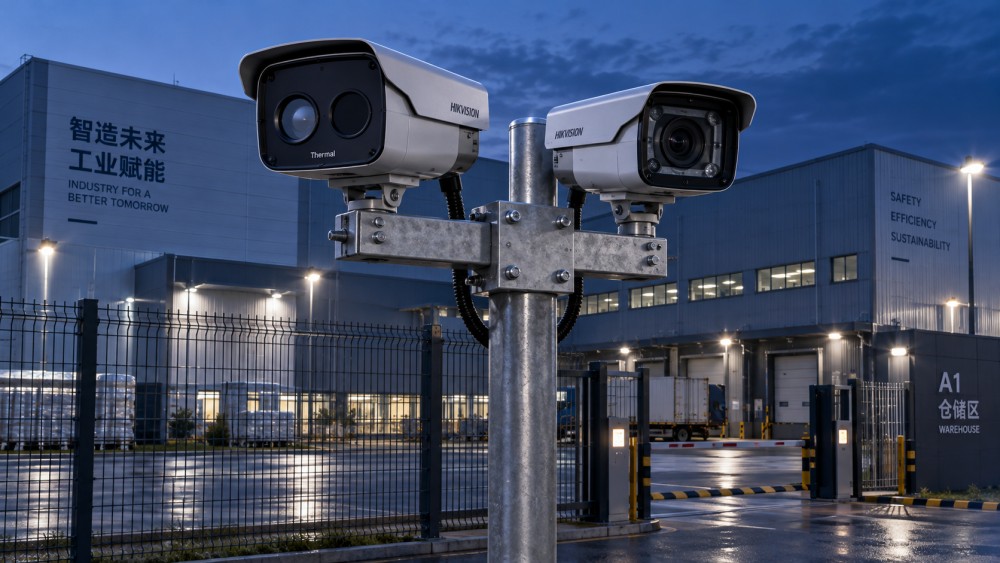
At utility compounds, storage yards, and remote infrastructure sites, maintaining uniform illumination can be difficult. Shadows move, lamps fail, and headlights change camera exposure. A thermal camera can detect a person crossing an unlit boundary without depending on those lighting conditions, provided the person has sufficient thermal contrast and occupies enough pixels.
The useful distinction is detection versus identification. Thermal imagery may show that a person is approaching a fence without establishing who that person is. A visible-light camera covering a gate or illuminated checkpoint can supply the identifying detail. Buying thermal solely to replace every conventional camera usually misunderstands this division of work.
For a perimeter review, compare both views of the same scene: one for the target’s separation from the background, the other for clothing, vehicle markings, and contextual detail. The images answer different operational questions.
Equipment conditions that appear as heat before visible damage
An overloaded connection, deteriorating bearing, or cooling problem may create abnormal surface heating before a conventional camera shows a visible change. Radiometric thermal imaging can support inspections and condition monitoring by locating hot spots or tracking temperature trends.
However, a hot spot is evidence to investigate, not a diagnosis. Electrical load, ambient conditions, emissivity, reflected radiation, and viewing angle influence interpretation. Comparing similar components under comparable operating conditions is generally more informative than judging an isolated temperature reading. Inspection procedures must also respect electrical safety requirements; a camera does not make opening an energized enclosure safe.
Some obscured scenes and difficult backgrounds
Thermal imaging can outperform visible imaging through some smoke conditions because attenuation differs by wavelength and particle characteristics. It may also help separate a warm target from visually cluttered surroundings. These advantages are conditional: dense smoke, water droplets, vegetation, and atmospheric absorption can still reduce usable information.
Do not accept “sees through fog” as a universal capability. Heavy fog and rain can shorten thermal detection range substantially. For a coastal perimeter or industrial site with recurring steam plumes, testing in representative conditions matters more than a clear-weather demonstration.
Where visible-light cameras remain the stronger choice
If the question is “What color was the vehicle?” or “What does the sign say?”, visible imaging is normally the right starting point. Thermal palettes are display choices, not real object colors. Thermal cameras should not be assumed to provide readable license plates, recognizable faces, or detailed documentation of a transaction.
Ordinary glazing is another decisive limitation. Standard window glass generally blocks the thermal bands used by common thermal cameras, so the camera sees the glass surface and its reflections rather than a clear thermal view beyond it. A visible camera can observe through a window, although reflections and lighting still need attention. Thermal installations may require an unobstructed view or a purpose-designed infrared window.
Visible systems can also be more economical where lighting is controlled and the task demands detailed recording. Before adding thermal hardware to a well-lit loading bay, check whether better lens selection, exposure settings, or lighting placement would solve the actual problem.
Darkness is not the only variable that determines performance
A thermal camera can work without light yet struggle when the target and background have similar apparent temperatures. This can occur during thermal crossover, when changing environmental conditions reduce contrast. Sun-heated surfaces, wet clothing, target size, and background materials can all affect detection.
The specifications worth examining depend on the job:
- Resolution and field of view: Together, they determine how many pixels cover a target at the required distance. A wide view may cover more ground while leaving too little target detail.
- Thermal sensitivity: Noise-equivalent temperature difference, or NETD, helps describe sensitivity to small temperature differences. Lower values can be useful, but comparisons require attention to stated test conditions.
- Lens and spectral band: These affect coverage, atmospheric performance, enclosure design, and suitability for the application.
- Measurement specifications: For radiometric work, confirm accuracy conditions, calibration requirements, measurement range, and emissivity adjustments.
- Environmental and service requirements: Check housing protection, operating temperature, lens cleaning, mounting stability, and maintenance obligations.
Long-range applications may justify cooled thermal systems, but their cost and service needs differ from those of common uncooled units. A quoted detection distance is not enough to justify either choice. Ask what target, weather, contrast, lens, and detection criterion produced that figure.
Combining sensors is often more useful than choosing a winner
A practical security arrangement lets thermal analytics detect an event and directs a visible camera toward it for assessment. This may use a dual-sensor unit, separate fixed cameras, or a thermal trigger linked to a pan-tilt-zoom camera. The architecture should follow the response process, not the appeal of a combined device.
Integration needs careful checking. Separate sensors may have different fields of view, mounting positions, and timing. An event visible in one stream may fall outside the other. Automatic camera positioning must be tested at near and far distances, and the operator should receive enough context to understand the alert.
Thermal video does not make analytics infallible. Wildlife, hot machinery, changing weather, and partial occlusion can cause missed or unwanted alerts. Validate analytics on the actual thermal stream rather than assuming that a model trained for visible imagery will transfer successfully.
Turn the comparison into an acceptance test
Start with a testable requirement: detect a person crossing a defined boundary, confirm a vehicle entering a restricted area, or flag abnormal heating on specified equipment. “Clear nighttime image” is too subjective to establish whether the system delivers what the site needs.
For surveillance, test target routes, distances, speeds, and partial obstructions. Include darkness, changing sunlight, and representative adverse weather where feasible. Record missed events, nuisance alarms, alert delay, and whether operators can verify what happened. For temperature monitoring, document operating load, measurement settings, reference methods, and repeatability.
Lifecycle cost should include more than cameras. Lighting, installation access, network capacity, recording, analytics licenses, cleaning, calibration, and servicing can change the comparison. Thermal may reduce reliance on lighting for detection, while visible recording may still be required for evidence.
Check interoperability and governance alongside image quality
Global Smart-Security & Space Intelligence (G-SSI) connects sensor benchmarking with the wider requirements of security and building systems. That perspective is useful here: a strong image is only one part of an operational solution. Video-management integration, alarm handling, access permissions, and links to building-management workflows deserve separate evaluation.
Where ONVIF compatibility is specified, verify the relevant profiles and supported functions; video streaming alone does not establish interoperability for analytics events or radiometric data. Likewise, ISO, IEC, and UL references should identify the applicable standard, scope, and supporting documentation rather than appear as general quality labels.
Thermal imagery is not automatically exempt from privacy obligations. Whether a stream constitutes personal data depends on identifiability, context, and how it is combined with other information. GDPR considerations and NDAA-related procurement restrictions address different issues and require separate, jurisdiction-specific review.
The decision should therefore be specific: use thermal when heat contrast answers the detection or monitoring question better; use visible imaging when detail and identification matter most. Where both are necessary, validate the combined workflow under the site’s hardest credible conditions before committing to a wider deployment.
Related News
Thermal Sensing
Curation by industry experts
Popular Tags
Related Industries
- How video analytics reduces false alarms in urban security monitoringImprove urban security systems monitoring with video analytics. Discover how smarter rules reduce false alarms, cut investigation workload, and preserve detection of critical events.
- Airport Smart Lighting Market: What Drives Demand for Airfield Upgrades?Explore the airport smart lighting market: discover how LED upgrades, smarter diagnostics, and infrastructure renewal drive demand—and how to assess long-term investment value.
- When Is Infrared Imaging Better Than Visible-Light Cameras?When is infrared imaging better than visible-light cameras? Discover where thermal excels, when visual detail matters, and how to choose the right cameras for security and monitoring.
Weekly Insights
Stay ahead with our curated technology reports delivered every Monday.