
Airport Smart Lighting Market: What Drives Demand for Airfield Upgrades?





An airfield lighting upgrade becomes commercially compelling when it solves an operational problem that replacing lamps alone cannot address. Aging circuits, difficult maintenance access, limited fault visibility, and changing runway or taxiway layouts can all create demand for modernization. Energy savings strengthen the case, but the value of better diagnostics and more reliable operation depends on how the airport actually uses and maintains its lighting.
The airport smart lighting market therefore covers several different investment decisions: converting conventional fixtures to LEDs, renewing electrical infrastructure, adding remote monitoring, and introducing more detailed control of individual lights or groups. These projects have different costs and benefits. Understanding which problem drives the purchase is more useful than treating every connected fixture as part of one uniform growth story.
What belongs in the airport smart lighting market?
Market boundaries matter because airport lighting can include terminal interiors, parking areas, apron floodlighting, and the visual aids used for aircraft approach and ground movement. A terminal occupancy sensor and a monitored runway light serve different purposes, face different operating constraints, and follow different procurement processes. Combining them can obscure where demand for airfield upgrades originates.
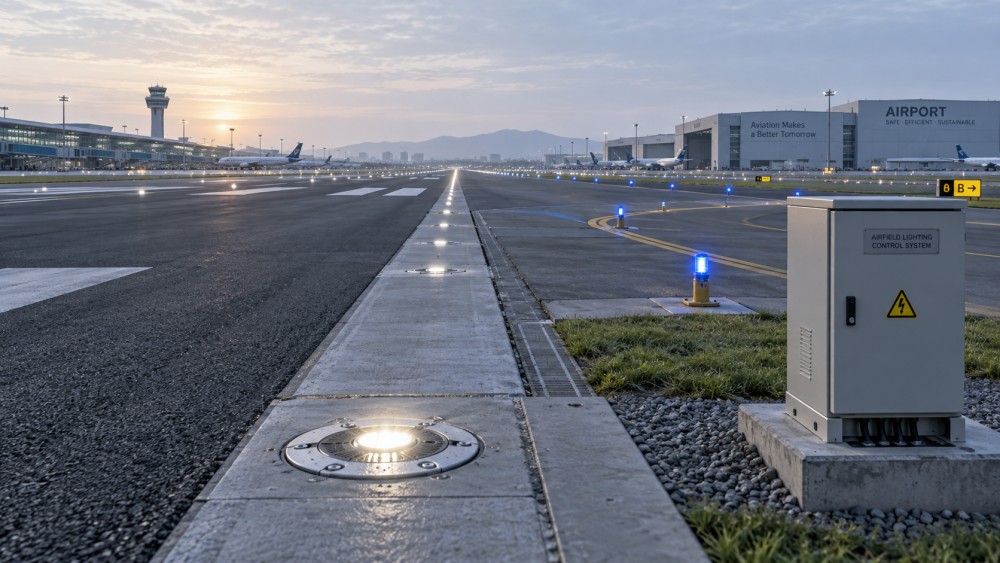
For airfield applications, the relevant system may include runway and taxiway fixtures, approach lighting, stop bars, power equipment, communications, and control and monitoring software. An LED fixture provides a lighting technology improvement. A smart system adds useful information or control, such as identifying a failed light, reporting circuit conditions, or managing defined lighting groups from an operator interface.
These capabilities do not always arrive together. An airport may install LEDs while retaining existing controls, or improve circuit monitoring before replacing every fixture. This creates a market with phased projects, varying levels of functionality, and substantial integration work alongside equipment sales.
Infrastructure renewal creates the clearest purchase trigger
Airports rarely replace serviceable airfield infrastructure simply because a newer system has more features. Demand becomes stronger when existing equipment is approaching replacement, faults are consuming maintenance resources, or planned construction makes electrical work practical. Runway rehabilitation, taxiway changes, and airport expansion can create opportunities to combine lighting improvements with wider civil works.
The condition of the underlying electrical system can determine the project scope. Many airfield lighting installations use series circuits supplied by constant-current regulators. Fixtures operate within a system that also includes cables, connectors, isolation transformers, and control equipment. Replacing the lights does not repair deteriorated cable insulation or unreliable connections.
This distinction affects market analysis. A tender described as an LED upgrade may involve extensive electrical renewal, while a controls project may preserve much of the installed lighting. Equipment revenue, installation effort, and delivery risk can differ substantially even when both projects are described as smart lighting modernization.
Where the infrastructure remains sound, a focused retrofit can be sensible. Where recurring faults originate across the circuit, broader renewal may offer better value than adding sophisticated monitoring to equipment already due for replacement.
Maintenance visibility can matter as much as electricity savings
LED conversion can reduce lighting electricity consumption, but the financial result depends on operating hours, intensity settings, existing equipment, and the efficiency of the complete electrical system. Savings should be calculated from the airport’s actual usage profile. A fixture-level comparison alone can overlook losses elsewhere in the installation.
Maintenance adds a different source of value. Access to runway and taxiway equipment must be coordinated with operations. Finding a fault, securing an access window, and returning the installation to service may require more effort than physically replacing the failed component. Better diagnostics can help teams arrive with the right parts and concentrate work within available closures.
The level of monitoring matters. A circuit alarm can indicate that a problem exists without locating it precisely. Individual-light monitoring may provide more detail, but it introduces additional components and communications requirements. The extra cost is easier to justify where fault location is difficult, lighting availability is operationally significant, or inspection access is constrained.
Condition monitoring also needs a clear interpretation. Electrical measurements may help identify developing problems, but they do not necessarily establish that a light delivers the required optical performance. Dirt, damaged optics, alignment errors, and pavement conditions can affect the visual aid. Remote diagnostics should support an appropriate inspection and maintenance program.
Safety requirements shape demand—and limit automation
Airfield lighting helps pilots interpret runway boundaries, taxi routes, holding positions, and other operational information. Upgrades must preserve the required visual characteristics and support the airport’s approved procedures. Applicable aviation requirements influence fixture selection, layout, intensity control, commissioning, and maintenance.
This gives “adaptive lighting” a more constrained meaning than it has in offices or public streets. An airport cannot assume that lights may be dimmed or switched off whenever a sensor detects little activity. Changes must respect operational conditions, established procedures, and the responsibilities of the personnel controlling the system.
Remote control and more detailed status information can still provide substantial value. They may help operators select defined configurations and help maintenance teams identify abnormal conditions. Where lighting is integrated with surface movement systems, interfaces, command authority, and failure behavior require particular attention. Connectivity alone does not establish a safety benefit.
Expansion can also increase the need for more structured control. Additional taxiways or more complex routing may make simple circuit-level operation less convenient. However, lighting is one part of the operating environment; an upgrade by itself does not guarantee increased runway capacity or access to lower-visibility operations.
Demand differs by airport operating conditions
Airfield size is only one indicator of opportunity. Traffic patterns, weather exposure, maintenance resources, infrastructure condition, and available construction windows often explain purchasing priorities more clearly. The following distinctions help separate projects that may otherwise appear similar.
Funding and project timing further influence demand. A technically attractive upgrade may remain deferred until it aligns with a capital program or a suitable closure window. Conversely, planned pavement work can make an otherwise marginal replacement worthwhile by reducing the disruption associated with a separate installation project.
Connected systems shift competition toward integration and support
As monitoring and control become part of the purchase, comparisons extend beyond fixture performance. The commercial offering includes software, interface engineering, alarm configuration, training, cybersecurity, and long-term support. A well-designed light can still become an expensive choice if its control system is difficult to maintain or integrate.
Interoperability needs a precise definition. Compatibility with an existing electrical circuit does not necessarily mean compatibility with its monitoring protocol. Exporting status data does not establish that another platform can safely issue commands. A proposal should identify which equipment has been validated together, what information can be exchanged, and who owns each interface.
A phased upgrade makes these questions particularly important. New and retained equipment may need to operate together for years. Responsibilities for mixed-system faults, software changes, and future expansion should be clear before procurement. Otherwise, an apparently economical first phase can restrict later choices.
Cybersecurity becomes relevant wherever remote access or network connections are introduced. Practical requirements include controlled user permissions, network separation, managed vendor access, event logging, and a defined update process. Local operating capability and predictable behavior during communications loss are especially important for an operational lighting system.
Cloud analytics may be useful for maintenance reporting, but their role should be distinguished from operational control. The commercial value depends on whether the service produces actionable information and fits the airport’s data and access policies. Adding connectivity without a defined use can create support costs without improving operations.
How to judge whether an upgrade offers credible value
A useful business case starts with a baseline: current energy use, recurring faults, inspection workload, spare-parts availability, and equipment condition. It should then separate the benefits of LED conversion from those of monitoring, control, and infrastructure renewal. This prevents a combined proposal from attributing every improvement to its “smart” features.
Lifecycle cost should include more than fixtures and installation. Relevant items include software licenses, support contracts, spare components, training, communications equipment, commissioning, and future replacement compatibility. Installation costs should reflect restricted working hours, temporary arrangements, and the sequence required to keep the airport operating.
Benefits need different treatment according to their evidence. Measured electricity use can support an energy calculation. Maintenance savings depend on the actual fault history and workflow. Avoided disruption may be valuable, but assigning a large financial benefit to every detected fault can exaggerate the return. Scenario analysis is more useful than a single optimistic payback figure.
Operational acceptance criteria make the investment concrete. They can cover required lighting performance, alarm accuracy, response during communications loss, restoration after power interruption, and operation with retained equipment. These requirements connect the purchase to outcomes that can be demonstrated during commissioning.
Long-term service arrangements also affect value. Procurement should establish how long replacement components will be supported, whether configuration data remain accessible, and how the airport can maintain the installation if its service provider changes. These questions are particularly relevant when software and proprietary communications become essential to everyday operation.
Read market momentum through project quality
The strongest demand signals are projects tied to identifiable operational needs: infrastructure replacement, airfield expansion, constrained maintenance access, or control requirements that existing systems cannot meet. Announced interest in automation is a weaker indicator unless it translates into funded work with a defined scope.
Market estimates should be read alongside their boundaries. A forecast covering terminals and apron lighting describes a different opportunity from one limited to runway and taxiway systems. Hardware-only estimates also differ from those including installation, software, and services. These distinctions affect how growth translates into opportunities for manufacturers, integrators, and maintenance providers.
For an airport considering modernization, the most useful next step is to identify where the current lighting system consumes money, limits maintenance, or complicates operations. That diagnosis determines whether the right investment is a straightforward fixture replacement, targeted monitoring, or wider electrical and control renewal. Demand for smart lighting becomes durable when the added capability has a clear operational purpose and a supportable lifecycle cost.
Related News
Thermal Sensing
Curation by industry experts
Popular Tags
Related Industries
- ASELSAN Says EJDERHA AD Disabled 51 Drones in a Single TestASELSAN says EJDERHA AD disabled 51 drones in seconds without missiles. Discover what the test reveals about electromagnetic counter-drone defense.
- How to prepare HVAC procurement specifications for Middle East heatMaster procurement specification preparation Middle East projects need. Learn how to compare HVAC bids, address extreme heat and define clear acceptance criteria.
- FBI Exposes FaceStealer Campaign Using Stolen Video to Bypass Face ChecksFBI exposes the FaceStealer campaign's use of stolen video to bypass facial liveness checks. Explore the risks and lessons for businesses.
Weekly Insights
Stay ahead with our curated technology reports delivered every Monday.