
Physical Security Upgrades That Cut False Alarms





False alarms drain budgets, disrupt operations, and weaken trust in Physical Security systems across Critical Infrastructure and Smart City environments. This article explores practical upgrades—from Infrared Sensing and advanced sensors to Digital Twin validation and stronger Data Governance—that align with Security Standards and improve Industrial Security and Urban Security performance. Learn how smarter sensor manufacturing choices and system design can cut nuisance alerts without sacrificing protection.
For operators, every unnecessary dispatch interrupts workflows and pulls staff away from real incidents. For project managers and procurement teams, high false alarm rates can expose weak specification practices, poor device matching, or incomplete commissioning. For CSOs and security managers, the issue is broader: nuisance alerts reduce confidence in monitoring centers, distort risk reporting, and can increase response times when a real threat appears.
In modern B2B environments, cutting false alarms is rarely about replacing one device. It usually requires a layered upgrade across sensing, analytics, installation quality, data governance, and validation processes. The most effective programs combine better hardware selection, cleaner event logic, tighter environmental calibration, and measurable review cycles over 30, 60, and 90 days.
Why False Alarms Remain a System Design Problem, Not Just a Device Problem
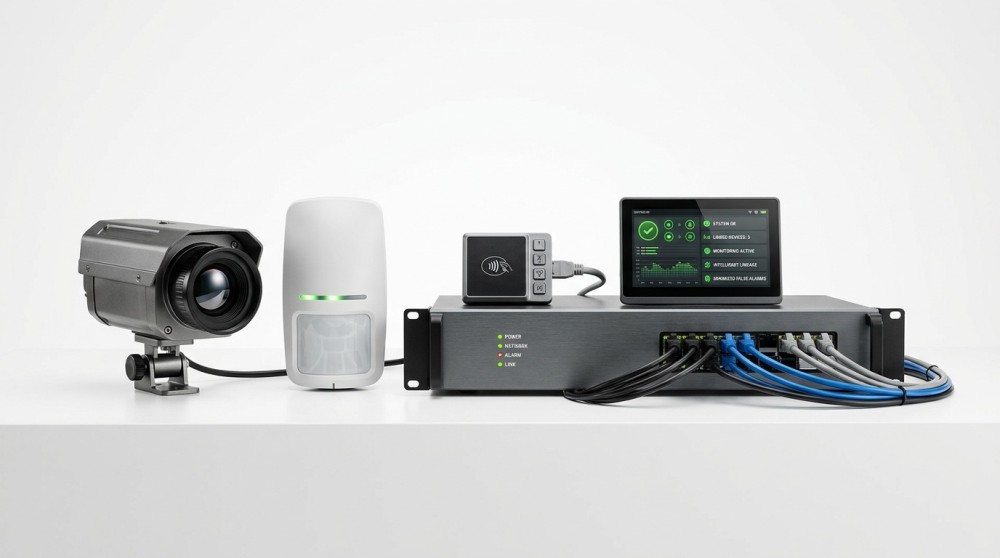
Many organizations still treat false alarms as isolated hardware faults, yet the root causes are often systemic. In campuses, transport hubs, industrial plants, and mixed-use urban sites, nuisance alerts commonly come from a mismatch between sensor type, mounting height, field of view, lighting variation, thermal contrast, access schedules, and alarm logic. A camera or detector may perform as specified in a laboratory, but fail in a windy perimeter, reflective loading bay, or high-traffic lobby.
In practical terms, even a false alarm rate of 3% to 8% across thousands of daily events can overload operators. A site generating 1,000 alarm-related events per day may create 30 to 80 low-value incidents that require review, logging, or guard dispatch. Over a month, that becomes 900 to 2,400 distractions, increasing fatigue and reducing confidence in the wider Physical Security program.
Another recurring issue is fragmented ownership. Video surveillance teams may tune analytics one way, access control teams another, and building management teams may change HVAC, lighting, or door automation settings without reviewing downstream alarm impacts. In critical infrastructure, small changes in airflow, vibration, or thermal load can materially alter sensor behavior within 24 to 72 hours of commissioning.
This is where multidisciplinary review matters. Organizations such as G-SSI emphasize benchmarking against standards like ISO, IEC, ONVIF, and UL not simply for compliance, but because structured interoperability and commissioning practices help reduce event ambiguity. A lower false alarm rate is often the outcome of aligned architecture rather than a single “smart” device upgrade.
Common root causes seen in operational environments
- Improper detector placement, such as mounting motion devices too high or too close to air vents, doors, or reflective surfaces.
- Uncalibrated video analytics in scenes with strong headlight glare, shadows, rain, fog, or crowd density changes across 2 to 3 shifts.
- Weak integration between access control, visitor management, and intrusion logic, causing authorized movement to trigger unnecessary alerts.
- Inconsistent maintenance intervals, where dirty lenses, degraded housings, or drifting thermal performance change event accuracy over 6 to 12 months.
What decision-makers should measure first
Before approving upgrades, quantify three baseline indicators: alarms per device per week, verified false alarm ratio, and average operator handling time per event. These metrics are more actionable than total alarm volume alone. A site with 120 alarms per day may be healthier than one with 40 if the first has strong verification logic and the second forces repeated manual review.
Sensor and Detection Upgrades That Reduce Nuisance Events
The first practical upgrade path is better sensor matching. Different environments require different detection physics. Visible-spectrum cameras can struggle in low light, strong backlight, or cluttered backgrounds, while thermal and infrared sensing can maintain target contrast in darkness, haze, or variable illumination. That does not mean thermal is always superior; it means the sensing layer should be selected by scene conditions, target type, stand-off distance, and operational objective.
For outdoor perimeters, combining dual-technology detectors, thermal imaging, and rule-based analytics often outperforms a single modality. For example, a perimeter with 150 to 300 meters of exposure may benefit from thermal confirmation before creating a high-priority dispatch. In loading yards or substations, anti-climb detection can be paired with line-crossing rules and time schedules so weather movement does not generate the same priority as a person-sized thermal signature.
Sensor manufacturing quality also matters. Procurement teams should review ingress protection, operating temperature range, low-light thresholds, calibration stability, firmware update cadence, and test records under real environmental conditions. A detector rated for -20°C to 55°C but deployed in an enclosure with poor ventilation may drift faster than expected. Similarly, a low-cost camera may meet resolution requirements but lack the dynamic range needed to suppress headlight-triggered analytics errors.
A useful upgrade strategy is to classify zones into at least 3 categories: low-risk convenience spaces, controlled operational spaces, and high-value or critical areas. The sensing stack should become more redundant as risk increases. In high-value zones, two-factor event validation at the sensor level can reduce operator burden without slowing response to a confirmed incident.
Where specific sensor types fit best
The table below compares common upgrade options by environment, false alarm resistance, and implementation notes. These are planning references rather than fixed design rules.
The key takeaway is that hardware upgrades should be scenario-driven. A better specification often means mixing modalities, not overpaying for a single premium device. For many sites, the most cost-effective result comes from upgrading 20% to 30% of the highest-noise zones first, then expanding based on validated reductions in nuisance events.
Technical selection criteria for buyers and engineers
- Define target characteristics: human, vehicle, heat source, door event, or environmental anomaly.
- Map operating conditions across day, night, seasonal temperature shifts, and high-wind or heavy-rain periods.
- Specify verification logic: single trigger, dual trigger, or sensor-plus-video confirmation within 3 to 10 seconds.
- Request commissioning support and re-tuning windows, ideally with a 30-day post-install review cycle.
Using Digital Twin Validation and IBMS Integration to Test Alarm Logic Before It Fails Live
One of the most underused upgrades in Physical Security is pre-deployment validation using Digital Twin methods. In complex campuses, airports, utilities, logistics parks, and smart buildings, alarm behavior depends on flows, schedules, environmental conditions, and interaction between subsystems. A Digital Twin does not eliminate real-world testing, but it helps teams model how sensors, cameras, access points, and IBMS events interact before a flood of nuisance alerts reaches the control room.
For example, a badge-authorized door forced open for 45 seconds during shift change may be normal in one zone and a serious anomaly in another. If the access control policy, CCTV analytics, and building occupancy logic are not harmonized, the same event may generate 2 to 4 duplicate alarms. Digital Twin validation can simulate these conditions and reveal where event rules overlap, conflict, or miss critical context.
IBMS integration is equally important. HVAC cycles, elevator state changes, lighting transitions, and door automation all affect the security layer. In high-spec facilities, integrating security rules with building states can suppress known non-threat events while preserving escalation paths for real incidents. This is especially relevant in smart city assets and industrial facilities where building behavior changes by time of day, occupancy density, or maintenance mode.
Organizations that validate alarm logic in 3 stages—design review, simulated operation, and live pilot—typically identify issues earlier than those relying only on installation acceptance. Even a 2-week simulation and pilot period can reveal priority conflicts, camera blind spots, or rule duplication that would otherwise burden operators for months.
A practical validation workflow
- Stage 1: Build a device and event map covering entrances, perimeter lines, restricted areas, and maintenance zones.
- Stage 2: Model expected behaviors across at least 3 conditions, such as normal operations, shift transitions, and emergency override states.
- Stage 3: Run a live pilot in the noisiest 10% to 15% of zones and compare expected versus actual event output.
- Stage 4: Adjust dwell times, confidence thresholds, schedules, and escalation rules before full deployment.
Where Digital Twin work produces the fastest payoff
The strongest early returns usually appear in sites with overlapping systems: multi-building campuses, substations, transport nodes, industrial processing plants, and high-traffic urban estates. These environments often have 4 or more operational data streams influencing alarm behavior, making pre-validation more valuable than repeated reactive tuning.
Data Governance, Event Correlation, and Alarm Prioritization That Operators Can Trust
Reducing false alarms is not only a field hardware task. Data governance determines whether alarm signals arrive with enough context to support fast, accurate decisions. Poorly governed systems often produce duplicated events, inconsistent timestamps, incomplete audit logs, and conflicting priorities between platforms. In a critical environment, a 20-second delay caused by event confusion can matter more than a minor hardware specification difference.
A mature governance model should define event taxonomy, retention policy, escalation ownership, and synchronization rules across video, access control, intrusion, and IBMS systems. At minimum, teams should normalize alarm categories into 4 to 6 priority levels. A person detected after-hours at a restricted transformer yard should not be treated the same as a scheduled cleaner opening a lobby door 15 minutes before shift handover.
Event correlation is where many upgrades deliver immediate operational benefit. Instead of treating every trigger independently, the platform should evaluate whether multiple data points support the same incident. A card swipe, door open event, and video-confirmed authorized face match within 5 seconds can automatically downgrade an alert. By contrast, motion near a restricted area with no access credential and a sustained thermal signature may justify elevation to a high-priority incident.
Governance also intersects with privacy and procurement compliance. Enterprises operating across jurisdictions must consider GDPR-aligned data handling, NDAA-sensitive sourcing restrictions, retention windows, and secure audit access. These issues are not separate from false alarm reduction; weak governance often prevents teams from reviewing enough clean historical data to improve rules safely.
Operational governance controls worth standardizing
The table below outlines governance controls that frequently reduce alarm noise while improving accountability and forensic value.
The most important conclusion is that alarm quality improves when data quality improves. Sites that unify event naming, timestamps, escalation logic, and review ownership often see clearer incident handling even before major hardware replacement begins.
Four questions procurement and security leaders should ask suppliers
- How does the platform correlate video, access, intrusion, and building events within a defined time window?
- Can the system support zone-based policies and different thresholds for public, operational, and restricted areas?
- What audit, retention, and export controls exist for compliance and post-incident review?
- How often are firmware, analytics models, and integration connectors updated and validated?
Implementation Roadmap, Procurement Priorities, and Common Mistakes to Avoid
A false alarm reduction program works best when it is phased. Rather than replacing entire estates at once, many enterprises succeed with a 3-phase roadmap: baseline measurement, targeted upgrades in high-noise zones, and controlled expansion after validation. This approach reduces procurement risk, preserves budget flexibility, and gives engineering teams time to compare vendor claims with real operating performance.
During baseline measurement, collect 30 days of event data wherever possible. Segment by time, location, trigger type, operator action, and verified outcome. This quickly shows whether the biggest issue is environmental, procedural, or technical. In many sites, only 10% to 20% of devices generate the majority of low-value alerts, making focused remediation far more efficient than estate-wide refreshes.
Procurement should then prioritize systems that can be tuned, audited, and integrated, not just installed. Ask for site-specific testing methods, commissioning support, training for operators, and defined acceptance criteria such as alarm classification accuracy, re-tuning windows, and maintenance intervals. A lower purchase price can become expensive if the system requires weekly manual suppression or repeated guard dispatches.
Finally, avoid common mistakes. Overreliance on AI claims without scene testing, underestimating environmental variables, skipping post-install review, and treating governance as an afterthought are all frequent causes of disappointing outcomes. In a B2B security environment, sustained performance matters more than headline features.
Sample procurement and rollout checklist
- Define no more than 5 to 7 core use cases for each site phase, such as perimeter intrusion, after-hours access, vehicle gate anomalies, and restricted area occupancy.
- Require environmental fit documentation, including lighting, temperature, weather exposure, and line-of-sight conditions.
- Set a pilot duration of 2 to 6 weeks for high-noise zones before full rollout.
- Establish post-go-live review points at 30, 60, and 90 days with engineering and operations teams present.
FAQ: what buyers and operators ask most often
How long does a typical false alarm reduction project take?
For a focused pilot in a single building or perimeter zone, planning and commissioning may take 2 to 4 weeks, followed by a 2 to 6 week validation period. Multi-site critical infrastructure programs usually take longer because integration, governance review, and compliance checks must be coordinated across teams.
Which areas should be upgraded first?
Start with zones generating the highest review burden: outdoor perimeters, loading docks, shift-transition entrances, and mixed-use areas where authorized and unauthorized movement are difficult to separate. These zones often yield the fastest improvement when thermal verification, better analytics, or event correlation is introduced.
What acceptance criteria are reasonable?
Reasonable criteria vary by site, but buyers should define measurable thresholds such as verified false alarm ratio, operator handling time, event correlation success, and re-tuning response time. Acceptance should reflect operational conditions, not just bench tests or vendor demos.
False alarm reduction is most effective when organizations treat Physical Security as an integrated architecture spanning sensing, analytics, building systems, and governed data flows. Better Infrared Sensing, smarter sensor manufacturing choices, Digital Twin validation, and stronger event governance can materially improve Industrial Security and Urban Security outcomes without weakening protection.
For information researchers, operators, engineering leads, and enterprise decision-makers, the priority is clear: identify the highest-noise zones, validate alarm logic before broad rollout, and procure systems that can be measured, tuned, and audited over time. If you are evaluating upgrades for critical infrastructure, smart buildings, or urban security programs, contact us to discuss a tailored roadmap, compare technology options, or request a more detailed solution assessment.
Related News
Thermal Sensing
Curation by industry experts
Popular Tags
Related Industries
- Which chemicals market updates matter for refrigerant procurement budgets?Chemicals market updates reveal the refrigerant supply, regulatory, and pricing risks that shape smarter procurement budgets and resilient critical infrastructure.
- How GDPR shapes biometric access control deployments in EuropeBiometric access control Europe: learn how GDPR affects lawful basis, DPIAs, secure architecture, retention, vendor contracts, and inclusive deployment planning.
- When edge AI analytics can reduce cloud video processing costsEdge AI analytics can cut cloud video processing costs by filtering events locally, reducing bandwidth, storage, and inference demand. Explore a smarter hybrid surveillance strategy.
Weekly Insights
Stay ahead with our curated technology reports delivered every Monday.