
What Are the Limitations of Thermal Night Vision?





What Are the Limitations of Thermal Night Vision?
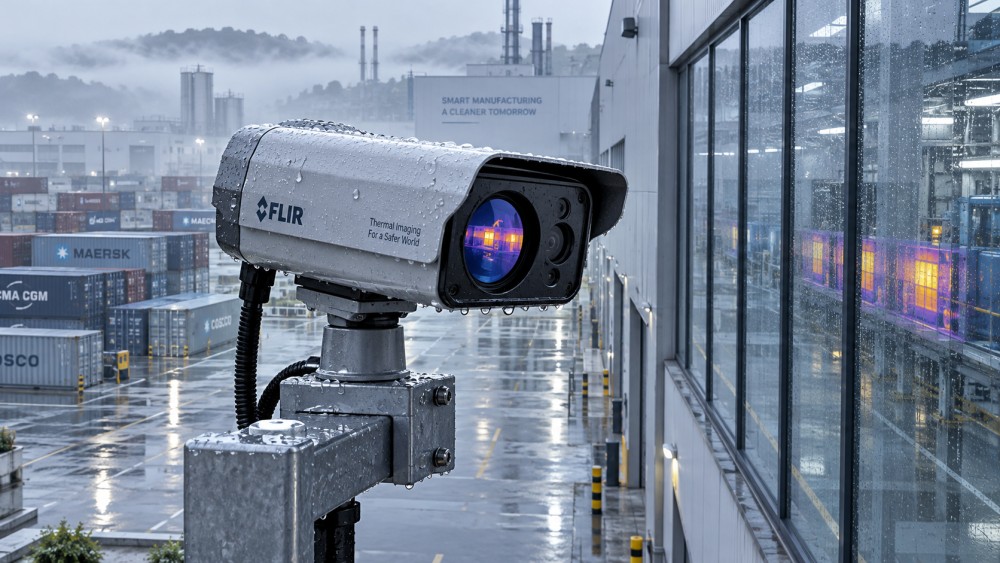
What are the limitations of thermal night vision? The answer can determine whether a surveillance investment delivers reliable protection or leaves critical blind spots. Thermal imaging detects differences in infrared radiation without needing visible light, but it cannot see through walls, generally cannot image through ordinary window glass, and may lose effectiveness in heavy rain, fog, or low thermal contrast. Detection also does not guarantee identification.
These limitations do not make thermal cameras unsuitable for security. They make the deployment conditions important. A camera that detects movement across an open perimeter may be unable to establish who entered, what they carried, or whether the event justifies a response. Reliable system design starts by separating those tasks rather than treating “night vision” as a single capability.
Thermal imaging sees surfaces, not everything behind them
Unlike image-intensified night vision or visible-light cameras with infrared illumination, thermal cameras form images from emitted and reflected thermal infrared radiation. Many security models operate in the long-wave infrared band; other systems use different bands. That distinction matters because materials and atmospheric conditions transmit different wavelengths differently.
A wall normally blocks the camera’s view of a person behind it. Heat passing through a structure may eventually change its surface temperature, but that is not a direct image of the concealed person. Building diagnostics can use such surface patterns to investigate heat loss or other anomalies; security operators should not interpret them as reliable through-wall surveillance.
Ordinary window glass is another common misunderstanding. It generally does not transmit the wavelengths used by long-wave thermal security cameras. The camera therefore sees radiation from the glass surface and reflections rather than a clear view through it. Placing a thermal camera behind a conventional office window can defeat the intended surveillance function. Specialized infrared-transmitting windows exist, but their material, spectral compatibility, and environmental performance require verification.
Vegetation, parked vehicles, containers, and structural columns also create occlusion. A thermal sensor may reveal a person through gaps in foliage, but it does not make dense vegetation transparent. Coverage planning still requires sightline analysis, mounting-height decisions, and checks for seasonal growth.
Bad weather reduces the usable range
Thermal imaging often performs better than visible imaging in darkness and some obscured conditions. That advantage is relative, not unlimited. Fog, rain, snow, and humid air can absorb or scatter infrared radiation, weakening the contrast arriving at the detector. The outcome depends on the spectral band, path length, weather intensity, and target characteristics.
A quoted maximum detection distance is consequently not a promise of year-round coverage. Light mist across a short yard and dense fog across a long waterside boundary are different operating problems. Smoke is similarly variable: thermal imaging can help in some smoke conditions, but performance depends on its composition and density as well as the camera’s band.
Weather also affects the equipment directly. Water droplets, ice, dirt, or salt deposits on the lens window can degrade the image even when atmospheric transmission is acceptable. Enclosure protection does not guarantee a clean optical path. Exposed installations need practical provisions for cleaning, drainage, heating where appropriate, and safe maintenance access.
Low thermal contrast can hide an otherwise visible target
A thermal camera does not simply highlight anything alive. It needs a measurable difference between the target and its surroundings. When clothing, ground, walls, and vegetation have similar apparent temperatures, a person may be difficult to distinguish even though the camera is functioning correctly.
This can occur during thermal crossover, when changing conditions bring objects and backgrounds close in temperature. Dawn and dusk can be challenging, although timing varies with materials, weather, and solar exposure. Hot industrial surfaces and sun-warmed pavement introduce a different problem: a complex background in which people are no longer the most prominent thermal features.
Clothing further complicates interpretation. The camera sees the outer surface of garments, not body temperature directly. Insulating or wet clothing can alter the apparent signature. Reflective metal can show radiation from surrounding objects, producing patterns that are easy to misread as local heat sources.
For acceptance testing, include both high-contrast and low-contrast scenes. A demonstration featuring a warm person against a cool, uncluttered background proves much less than repeated testing against the actual pavement, vegetation, machinery, and structures on site.
Detection is not recognition—and recognition is not identity
A distant thermal image may establish that something is present without showing whether it is a person, an animal, or another moving object. With more usable detail, an operator or analytic may classify it as human. Establishing a specific individual’s identity is a separate task that ordinary thermal surveillance generally cannot perform reliably on its own.
Color, printed text, facial detail, and license plates are usually better handled by an appropriately configured visible-light camera. Thermal footage may document movement or intrusion, yet still provide insufficient detail for investigation. If identification matters, the design needs a complementary capture point with suitable lighting, angle, exposure, and resolution.
Range claims should therefore specify the task. Detection, recognition, and identification estimates depend on target size, lens selection, detector resolution, contrast, and the performance model used. Ask what the supplier means by each term and whether the estimate applies to human observers, automated analytics, or both.
A narrow field of view can put more pixels on a distant target, but it covers less area. A wide-angle camera offers broader coverage with less target detail at distance. Digital zoom enlarges existing pixels; it does not recover information the detector never captured.
Specifications help, but no single parameter predicts performance
Noise-equivalent temperature difference, commonly abbreviated NETD, describes thermal sensitivity under stated test conditions. A lower value can support the detection of smaller temperature differences. It does not, by itself, establish surveillance range, classification accuracy, or performance in fog. Optical quality, spatial resolution, processing, and scene conditions remain relevant.
Detector resolution and lens focal length should be evaluated together. Frame rate, network latency, compression, and display quality also influence what operators can interpret, particularly when tracking moving targets. Aggressive noise reduction may make an image look cleaner while obscuring small details.
Some cameras perform periodic non-uniformity correction to manage detector drift. Depending on the design, this can briefly interrupt or freeze the image. Procurement teams should establish whether such behavior affects tracking, recording, or alarm continuity rather than discovering it during operation.
Cooled thermal systems can support demanding long-range applications, but cooling assemblies add cost, power requirements, and maintenance considerations. Uncooled systems are often simpler to deploy, yet still require careful optical and environmental selection. The correct comparison is lifecycle suitability for the surveillance task—not simply cooled versus uncooled.
Analytics cannot repair missing visual information
AI-based thermal analytics can filter motion events and classify targets, but they remain dependent on the image. Occlusion, weak contrast, insufficient target pixels, and unfamiliar viewpoints can lead to missed detections or false alarms. Confidence scores should not be treated as guarantees.
The operational impact depends on the site. An alarm near a continuously staffed control room may be verified quickly. The same alarm on a remote perimeter may trigger a lengthy dispatch. Sensitivity settings must reflect both the consequence of a missed intrusion and the workload created by nuisance alerts.
Integration deserves equal attention. A camera can produce a useful image while its events fail to reach the video management system correctly. Verify timestamps, alarm metadata, recording triggers, health monitoring, and recovery after network or power loss. ONVIF compatibility can support interoperability, but the relevant profiles and supported functions still need checking on the actual devices and software.
Turn the limitations into an acceptance test
A useful evaluation begins with a measurable task: detect a person crossing a defined boundary, classify the event, and deliver an alarm within an agreed interval. Avoid requirements such as “clear night vision” that leave success open to interpretation.
- Test the furthest required boundary and the edges of the field of view, not only the center.
- Include different approach directions, partial occlusion, representative clothing, and slow movement.
- Record weather, scene conditions, camera settings, missed events, and nuisance alarms so results can be compared.
- Check alarm delivery and usable recorded evidence, not just the live image.
- Agree how untested seasonal conditions will be validated before final acceptance.
Thermal surveillance also needs data governance. Footage can reveal movement and behavior even without recognizable faces. Applicable privacy obligations depend on the jurisdiction and use case; restricted access, retention controls, secure transmission, and audit records should be considered alongside image performance. Thermal imaging is not automatically outside privacy regulation.
Use thermal where it adds evidence, not where it creates assumptions
The strongest deployments often combine thermal detection with visible-light verification, access-control records, or other appropriate sensors. Those layers should address different weaknesses. Two cameras sharing the same obstructed sightline do not provide meaningful resilience against that obstruction.
This system-level approach fits the role of Global Smart-Security & Space Intelligence (G-SSI): connecting thermal and infrared sensing benchmarks with video analytics, access control, building systems, and data-governance requirements. Cross-disciplinary evaluation helps distinguish a capable sensor from a dependable operational solution, without assuming that one standard or specification proves overall suitability.
Before approving a deployment, establish what thermal imaging must detect, what another sensor must verify, and what happens when conditions degrade. Require documented assumptions behind range claims and test the installed system against them. Darkness may be the problem thermal imaging solves; weather, obstruction, identification, and response still need their own answers.
Related News
Thermal Sensing
Curation by industry experts
Popular Tags
Related Industries
- How to test an intelligent video monitoring platform for false alarmsTest an intelligent video monitoring platform for false alarms, missed events, and alert workload. Discover practical metrics to compare vendors and choose with confidence.
- Tactien Group Launches CAST for Critical Infrastructure Counter-UAS TestingTactien Group launches CAST for critical infrastructure counter-UAS testing. Explore how independent assessments can support smarter procurement and performance verification.
- How do 4K and 8K CCTV cameras compare in low-light conditions?Security equipment comparison: CCTV cameras in 4K vs 8K face different low-light challenges. Discover how sensors, motion blur, and infrared affect footage—and choose with confidence.
Weekly Insights
Stay ahead with our curated technology reports delivered every Monday.