
What Affects Infrared Imaging Detection Distance?





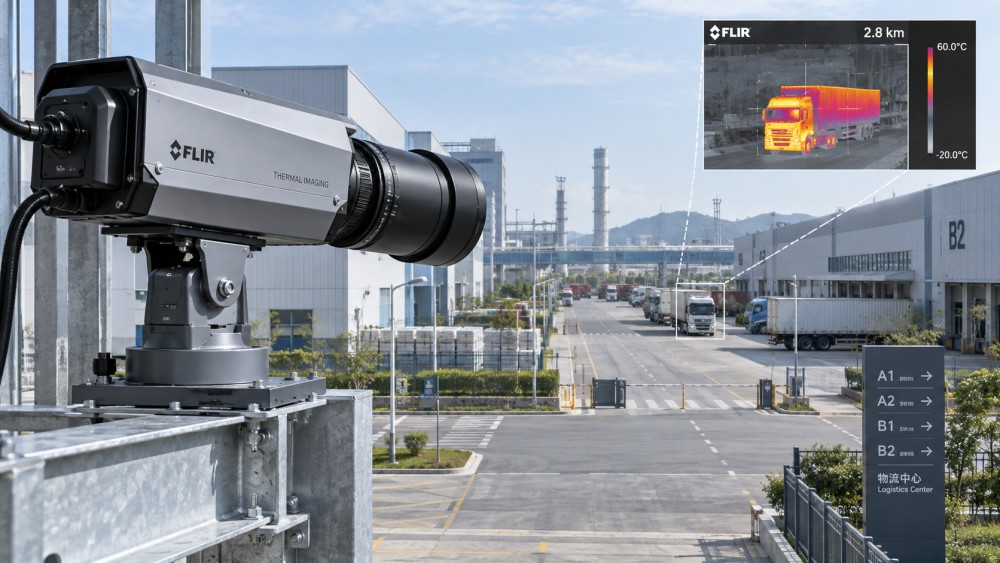
Infrared imaging detection distance is governed by how much usable thermal detail reaches the detector. Target size, temperature contrast, lens focal length, pixel pitch, optical quality, atmospheric transmission, and image processing all affect that detail. A distant object must occupy enough pixels and remain distinguishable from its background. Improving one specification does not guarantee a longer operational range if another part of the imaging chain limits performance.
Advertised range therefore needs a defined target, task, and environment. Detecting a warm vehicle against open ground is a different problem from detecting a stationary person beside sun-heated equipment. A useful comparison starts with these conditions, then examines which camera characteristics address the actual limitation.
Detection, recognition, and identification require different amounts of detail
Detection establishes that an object of interest is present. Recognition supports classification, such as distinguishing a person from an animal or vehicle. Identification requires enough detail to determine a more specific object type or relevant distinguishing features. In thermal surveillance, identification does not automatically mean establishing a person's identity.
These tasks have progressively shorter useful ranges for the same target and camera. An object might appear as a small thermal disturbance well before its outline becomes clear enough for classification. A range claim based on detection cannot establish whether the system will support a response requiring recognition.
Traditional range calculations sometimes use Johnson-style criteria, which relate task performance to resolvable detail across a target. Such estimates depend on assumptions about target dimensions, contrast, probability of success, and imaging conditions. Human observation and automated analytics also have different performance requirements. A calculated detection distance is a starting point for comparison, rather than evidence of dependable alarm generation.
Target size and thermal contrast set the difficulty
A larger target occupies more of the image at a given distance. However, the dimension relevant to the task matters more than the object's overall size. A vehicle's broad side presents different detail from its front. A standing person, a crouching person, and a partially concealed person produce different apparent dimensions even at the same location.
Thermal contrast is the difference in apparent infrared radiance between the target and its surroundings. Temperature contributes to this difference, but emissivity, reflected radiation, clothing, and surface condition also affect it. Bare metal can reflect thermal radiation from the sky or nearby structures, creating an appearance that differs substantially from its actual temperature.
Backgrounds change during the day. Sun-heated pavement and walls can approach the apparent temperature of a person or vehicle, reducing separation. Around thermal crossover periods, when target and background radiance become similar, a camera that performed well earlier can lose useful contrast. The timing and severity depend on weather, materials, and how quickly each surface heats or cools.
Clothing further complicates human detection because the camera sees the outer surface. Heavy insulation reduces some visible temperature differences, while exposed areas remain small. Foliage, barriers, and machinery remove portions of the target from view. Thermal imaging does not restore detail hidden behind opaque obstacles.
Lens reach versus detector resolution
Focal length determines the target's image scale. With the same detector and pixel pitch, a longer focal length places more pixels across a distant object and narrows the field of view. This supports greater range when spatial detail is the limiting factor, but reduces the area visible in each frame.
Pixel pitch is the physical spacing between detector pixels. For a small angular target, the approximate number of pixels across a dimension is:
Pixels across target ≈ target dimension × focal length ÷ (distance × pixel pitch).
All lengths must use consistent units. As a purely geometric example, a 1.8-meter target dimension at 1,000 meters, viewed through a 100-millimeter lens with 12-micrometer pixels, spans approximately 15 pixels. This calculation describes sampling only. It does not establish a detection probability or account for blur, atmospheric losses, low contrast, or occlusion.
Detector resolution and pixel pitch should therefore be compared together. A larger pixel count can provide wider coverage at a similar angular sampling level. It does not necessarily increase pixels on target if focal length and pixel pitch stay unchanged. Conversely, smaller pixels improve geometric sampling with the same lens, but the optics must resolve that finer detail.
Digital zoom enlarges the displayed image without adding independently captured information. Optical zoom changes target sampling, provided that focus and optical quality remain adequate. Treating the two as equivalent produces misleading range comparisons.
Sensitivity helps when contrast is weak; optics determine what survives
Noise-equivalent temperature difference, or NETD, describes thermal sensitivity under specified measurement conditions. A lower value indicates an ability to distinguish smaller temperature differences under comparable conditions. This becomes valuable when a target is only slightly different from its background.
NETD values require careful comparison because measurement temperature, lens aperture, integration settings, and processing influence the result. Detector-level sensitivity and complete-camera sensitivity are not interchangeable. A favorable number measured with one optical configuration does not establish equivalent performance with a different lens.
The lens's f-number affects how much radiation reaches the detector. A lower f-number admits more radiation for a given focal length, although actual transmission also depends on lens materials, coatings, and optical design. Long focal length alone says little about performance if the aperture and transmission leave the signal too weak.
Optical sharpness, expressed through modulation transfer characteristics, determines how well fine contrast reaches the image. Poor focus, aberrations, diffraction, and detector sampling all limit useful detail. A target can occupy many pixels while its edges remain too blurred for recognition.
Focus becomes especially demanding with narrow fields of view. Temperature changes can shift focus unless the optical design or focusing mechanism compensates adequately. Protective windows introduce another variable: their infrared transmission must match the operating band, and contamination or condensation reduces image quality even when the detector remains fully functional.
Cooled versus uncooled systems: compare the complete configuration
Cooled thermal cameras commonly offer advantages for demanding long-range tasks, including high sensitivity and configurations suited to resolving weak signals. Uncooled cameras offer simpler operation and support many surveillance applications. Neither category has a universal detection distance.
A cooled detector paired with a short lens can provide fewer pixels on a distant target than an uncooled detector paired with a longer lens. Conversely, when both systems deliver adequate sampling, sensitivity and optical performance can determine which retains useful contrast in difficult conditions.
Spectral band also matters. Many uncooled surveillance cameras operate in long-wave infrared, while many cooled long-range systems operate in mid-wave infrared. Atmospheric transmission, target radiance, and background behavior differ across these bands. There is no reliable rule that one band always sees farther: the comparison must include the target, weather, path length, and complete optical configuration.
Cooling should consequently be evaluated alongside focal length, aperture, pixel pitch, spectral response, and measured task performance. A detector technology label leaves too much of the imaging chain unspecified.
Atmosphere and installation can erase nominal range advantages
Infrared radiation loses strength as it travels through the atmosphere. Absorption and scattering reduce target contrast, while radiation emitted along the path contributes to the observed background. These effects become increasingly relevant over long paths and differ with wavelength and atmospheric conditions.
Fog, rain, snow, dust, and humid air affect transmission in different ways. Thermal imaging can outperform visible imaging in some obscurants, but dense fog and heavy precipitation still impose substantial limits. Relative humidity alone is insufficient to predict range; air temperature, water vapor along the full path, and the presence of droplets also matter.
Paths close to hot ground introduce additional difficulty. Turbulence and refractive variations distort fine detail, producing fluctuating edges or apparent shimmer. A longer lens magnifies these disturbances along with the target. Increasing focal length eventually offers diminishing benefit if the atmosphere has already removed the detail needed for classification.
Camera position changes the path and the background. An elevated view might reduce concealment by low vegetation, yet a steep downward angle can shorten a person's projected dimension. A low view across a heated surface creates a different atmospheric burden. Placement must account for both effects.
Mount vibration, wind loading, and pan-tilt stability become more consequential as the field of view narrows. Motion during an exposure blurs detail. Stabilization can reduce image movement, but it cannot fully recover information lost during capture. Lens contamination, housing-window fouling, and focus drift should also be considered when judging sustained range.
A clear-looking image does not guarantee a reliable detection event
Contrast enhancement often makes a thermal scene easier to interpret. However, automatic gain control redistributes displayed brightness according to scene content. A large hot object entering the frame can compress the visible contrast of a smaller target elsewhere. Comparisons made with different display settings can therefore exaggerate or hide differences between cameras.
Noise reduction has tradeoffs. Temporal averaging improves the appearance of a static scene, but moving targets can lose definition or develop trails. Strong spatial filtering removes noise while smoothing small features. Sharpening accentuates edges without restoring information that never reached the detector.
Automated detection introduces separate limits. An analytics model requires suitable target size, appearance, motion, and scene context. A person visible to a human examining a magnified frame might not trigger a dependable alarm. Conversely, motion-based detection can flag a disturbance without establishing whether it is a person, animal, or background movement.
Evaluate the image stream actually used for the task. Resizing, compression, frame-rate changes, and transmission settings can reduce detail between the camera and the analytics engine. A full-resolution local display does not prove that a reduced-resolution processing stream supports the same range.
Make range claims comparable before testing them
A meaningful range specification describes the target dimensions and orientation, required task, success criterion, lens setting, spectral band, and environmental assumptions. Modeled results should identify the model and its inputs. Field results should state how successful observations and missed events were counted.
Testing should include the weakest relevant contrast conditions, rather than only a favorable demonstration against a cold background. Stationary and moving targets reveal different limitations. Repeated observations around thermal crossover, with representative clothing and partial concealment, establish a stronger basis for comparison than a single clear image at maximum distance.
For alarm-based surveillance, record detection performance together with false alarms. Increasing sensitivity can extend apparent reach while producing excessive triggers from vegetation, wildlife, or changing background temperatures. The useful distance is the distance at which the specified task remains repeatable under the accepted alarm conditions.
When results fall short, identify whether the limiting factor is target sampling, contrast, transmission, blur, or analytics. Each calls for a different adjustment. A longer lens addresses insufficient sampling; it offers little remedy for an obstructed target or contrast lost in dense fog. That distinction turns a range figure into a practical system requirement.
Related News
Thermal Sensing
Curation by industry experts
Popular Tags
Related Industries
- How to choose industrial sensor technology for HVAC humidity controlChoose industrial sensor technology for reliable HVAC humidity control. Compare accuracy, condensation tolerance, BMS integration, and maintenance to find the right sensor for your system.
- How video analytics reduces false alarms in urban security monitoringImprove urban security systems monitoring with video analytics. Discover how smarter rules reduce false alarms, cut investigation workload, and preserve detection of critical events.
- Planning Counter-Terrorism Barriers for Crowded Venues Without Blocking AccessPlan counter terrorism barriers that protect crowded venues without blocking access. Discover practical guidance on pedestrian flow, emergency routes, and barrier selection.
Weekly Insights
Stay ahead with our curated technology reports delivered every Monday.