
Access Card Migration to Secure Credentials Without Disrupting Entry





Access card migration to secure credentials works best when doors, users, and credential policies move through a controlled transition together. Replacing every badge at once creates avoidable problems if readers cannot authenticate the new cards, access permissions fail to transfer, or employees arrive before their credentials are active. A phased rollout keeps entry available while progressively removing the weaknesses of the old system.
The first decision is whether the existing access system can support secure authentication throughout the credential-to-controller path. The second is how to maintain access during the change without allowing temporary compatibility settings to become permanent. Both decisions need to be settled before bulk credential issuance begins.
Define what “secure” must mean in the finished system
A new smart card does not automatically provide stronger access security. Some installations use a capable contactless chip but read only its publicly available identifier. If the reader treats that identifier as sufficient proof of identity, the system is not benefiting from the card’s cryptographic authentication features.
The target configuration should authenticate the credential using protected keys and a supported cryptographic protocol. It should also protect communications between the reader and the controller where the architecture allows. These are separate requirements: secure card authentication does not protect an exposed reader connection, and an encrypted reader connection does not strengthen a weak credential.
For example, OSDP Secure Channel can protect reader-to-controller communications when compatible devices are correctly configured. Ordinary Wiegand signaling does not provide equivalent cryptographic protection. An OSDP-capable reader therefore needs more than the correct wiring; Secure Channel must be enabled with properly managed keys.
Following the technical benchmarking perspective of Global Smart-Security & Space Intelligence (G-SSI), assess the installed configuration across the complete access path. A specification sheet describing encryption is less useful than evidence that the selected card application, reader configuration, controller interface, and credential management process use it correctly.
Survey the doors and workflows before choosing credentials
Build an inventory around access points, rather than relying only on a list of reader models. Identical readers can behave differently because of firmware, wiring, controller versions, or configuration. Record the credential technologies currently accepted, the reader interface, controller capacity, power arrangements, and any dependence on network connectivity.
Include gates, lifts, parking entrances, standalone locks, and shared tenant areas. These frequently follow different upgrade paths from centrally managed office doors. A badge may also support printing, lockers, time recording, or other services. Changing its identifier can interrupt those services even when building entry works correctly.
Separate confirmed capabilities from assumptions using an inventory such as this:
Use these findings to decide which readers can be reconfigured, which need replacement, and which doors require controller or cabling work. A reader replacement alone will not resolve an incompatible controller or an unprotected communications path.
Choose credentials around authentication and lifecycle control
For physical cards, prioritize a supported credential application with cryptographic authentication, controlled personalization, and a workable key-management model. Card frequency and chip branding alone are insufficient selection criteria. Require the supplier to describe how the proposed system authenticates cards and which configuration activates that behavior.
Clarify ownership of keys and credential data before procurement. Who generates the keys? Who can issue replacement cards? Can another authorized integrator maintain the deployment? What happens if a reader needs replacement or the issuing service becomes unavailable? These answers affect long-term maintenance as directly as hardware compatibility.
Production keys should be protected, access to them restricted, and default keys replaced. Where supported, key diversification gives credentials distinct derived keys, reducing the consequences of a single credential compromise. Recovery and backup arrangements need clear ownership so that protecting keys does not make legitimate maintenance impossible.
Mobile credentials may suit users who already have managed devices, but they introduce provisioning, phone replacement, battery, and device-policy considerations. Physical cards remain useful where personal phones are unsuitable or entry must work independently of them. If both formats are offered, apply consistent access permissions and revocation rules.
Biometrics should be evaluated as a separate access decision. Introducing them during a card migration adds enrollment, privacy, accessibility, and exception-handling work. Include them only where the access requirement justifies that additional scope.
Design a transition that has a clear end
Mixed credential support can keep people moving while readers and badges are replaced. It also preserves the exposure associated with legacy cards until their acceptance is disabled. The transition plan should therefore state which doors accept old credentials, who still needs them, and what evidence permits their removal.
Three arrangements are commonly practical:
- Readers accepting both technologies: useful when compatible readers can be installed before everyone receives a new credential. Legacy acceptance must later be disabled.
- Credentials carrying both technologies: useful when employees need one badge across upgraded and legacy doors. Upgraded readers must authenticate the secure application instead of falling back to the weaker component.
- Separate old and new credentials: useful when the technologies cannot share a badge or when independent cutover control is needed. Issuance records must link both credentials to the correct person.
Select the arrangement based on how people move through the site. A user-based rollout may work in an office with common entrances. A door-based rollout may suit separate buildings. Neither works well if employees routinely cross between upgraded and legacy areas without compatible credentials.
Plan the transition as a sequence: prepare infrastructure, enroll a pilot group, prove operation, expand issuance, disable legacy acceptance by zone, and retire obsolete records and equipment.
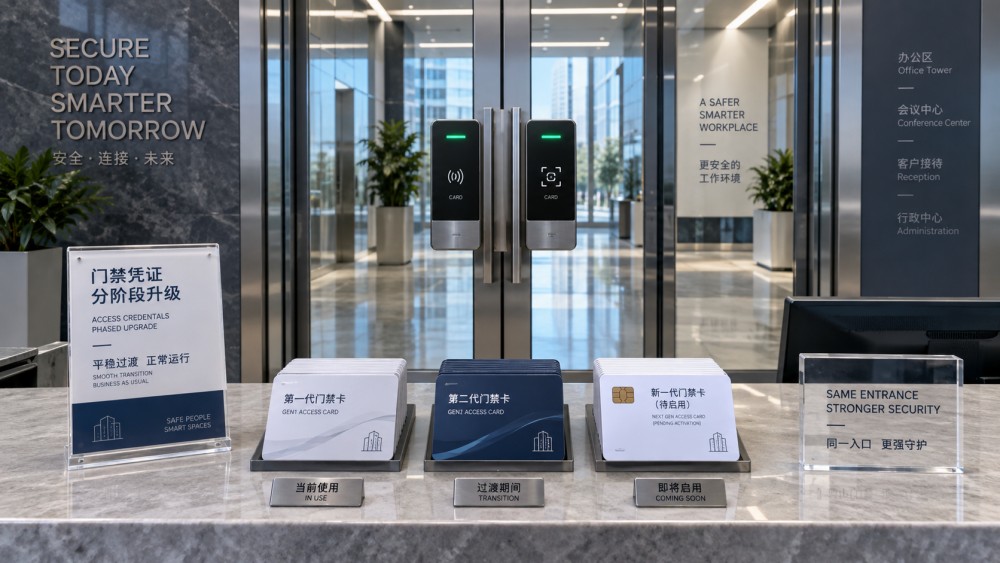
For sensitive areas, shorten coexistence or establish a separate cutover with staffed support. A long compatibility period at a critical door can undermine the purpose of upgrading it.
Preserve permissions while changing credential identifiers
Credential migration should retain the person’s identity record and associate the new credential with that record. Recreating users can introduce incorrect access groups, duplicate identities, or missing expiry dates. Preserve permissions, schedules, tenant boundaries, and approval history unless a separately authorized access review changes them.
Check how the system interprets credential numbers. Reader output, bit length, facility codes, and controller formatting can alter the value presented to the access database. Truncation or inconsistent interpretation may cause collisions, failed entry, or misleading event records. Test the full path from card presentation to the recorded access event.
During issuance, verify the recipient’s identity, activate the intended credential, and explain where it can be used. Avoid handing out inactive cards with an uncertain activation date. Contractors and visitors need explicit expiry rules, while replacement-card procedures should revoke lost credentials rather than leave them valid beside the replacement.
Allow access staff to see migration status clearly: issued, activated, tested, and legacy credential withdrawn. This prevents a badge-distribution count from being mistaken for completed migration.
Pilot normal entry and the failures that could stop it
A useful pilot represents the installed system. Include different reader and controller combinations, a busy entrance, an operationally important door, and users with different access schedules. If parking, lifts, or standalone locks are in scope, include them before approving wider issuance.
Test normal entry under realistic conditions. Confirm that authorized users enter, unauthorized users are denied, events show the correct identity, and the reader gives understandable feedback. Observe queues and repeated presentations rather than treating a single successful tap as sufficient evidence.
Then test the conditions most likely to expose weaknesses:
- Network loss and restoration, including local permissions and later event synchronization.
- Lost-card revocation and replacement, including doors that do not receive updates immediately.
- Controller or reader restart, with configuration and secure communication settings retained.
- Access schedules, expired credentials, anti-passback, and occupancy functions where used.
- Legacy-card rejection after compatibility is disabled on a representative upgraded door.
Keep emergency egress and fire-system interfaces within their established safety design. Credential troubleshooting must not obstruct escape routes. Test those interfaces through the appropriate authorized process, separately from ordinary badge acceptance.
Record failures by cause: credential provisioning, permission assignment, reader configuration, communications, or hardware. Each category needs a different remedy. Reissuing cards will not fix a controller-format mismatch.
Set release gates and a usable fallback
Before deployment, define what qualifies a zone for release. Acceptance should include successful entry for representative users, correct permission enforcement, reliable event recording, expected outage behavior, and confirmation that secure authentication is active. Set performance expectations around the actual entrance and its traffic.
Assign responsibility for each decision. Installation, credential issuance, access-policy approval, and operational acceptance may belong to different teams. A zone should advance only when the necessary evidence and operational sign-off are recorded.
Prepare rollback instructions while the existing configuration is still available. Keep configuration backups, spare components where justified, and a documented recovery sequence. Identify whether recovery means restoring reader settings, reverting a controller configuration, or providing controlled temporary access.
Fallback must fit the location. Staffed identity checks may be workable at a reception entrance. A restricted equipment room may require an approved escort process. Re-enabling legacy credentials restores their associated exposure, so any such exception needs a defined duration and an accountable owner.
Finish by proving the old access route has closed
Expand deployment in manageable zones, with support available during the shifts affected by each cutover. Notify users when their credentials become valid and where they can obtain help. Include night staff, temporary workers, and infrequent visitors in the communication plan.
After cutover, examine denied-entry events, repeated presentations, help-desk reports, and affected secondary services. Persistent failures often indicate an overlooked dependency. Keep each deployment wave open until those issues are resolved.
Completion requires more than distributing the final badge. Disable legacy technologies at upgraded readers, revoke obsolete credentials, remove unnecessary compatibility settings, and update configuration records. Where a door must remain on the old system, document it as an outstanding exception with an owner and a planned upgrade.
The most useful starting point is a verified door-and-credential inventory paired with a defined target configuration. Together, they show what can be reused, what must change, and which access paths need special handling. That evidence turns credential replacement into a controlled security improvement while keeping daily entry dependable.
Related News
Thermal Sensing
Curation by industry experts
Popular Tags
Related Industries
- Can a GPS tactical watch navigate without a phone connection?Can a GPS tactical watch navigate without a phone? Discover how standalone GPS, offline maps, and route guidance work—and what to check before heading off-grid.
- How does fog affect detection in perimeter thermal surveillance?Perimeter thermal surveillance can lose detection range in fog. Learn what affects reliability, how to test performance, and ways to strengthen your perimeter protection.
- Will a physical security platform work with your existing cameras?Will a Physical Security platform work with your existing cameras? Learn how to verify compatibility, preserve key features, and avoid costly migration surprises before you buy.
Weekly Insights
Stay ahead with our curated technology reports delivered every Monday.