
Infrared Industrial Fire Detection: Flame Sensors vs. Thermal Cameras





Infrared Industrial Fire Detection: Flame Sensors vs. Thermal Cameras
Selecting the right technology for infrared industrial fire detection requires more than comparing detection range or image resolution. Infrared flame sensors detect characteristic radiation from combustion, while thermal cameras map apparent surface temperatures to reveal abnormal heating that may precede ignition. That distinction shapes response times, nuisance-alarm risks, coverage, and integration with plant safety systems. Neither technology is a universal replacement for the other.
The practical question is where the intervention window sits. A fuel leak that ignites rapidly demands dependable flame recognition. A conveyor bearing that heats gradually may offer an earlier opportunity to stop equipment. Buying against the wrong event can leave a site with technically capable hardware that misses the condition it actually needs to detect.
Start with the fire scenario, not the sensor specification
Define the credible fuel, ignition mechanism, fire location, and required action before requesting proposals. Liquid-fuel handling, waste storage, electrical distribution, and combustible-material processing do not present the same detection problem. A detector intended to recognize an exposed flame does not necessarily identify concealed overheating. A camera monitoring an equipment enclosure may not see an internal fault until heat reaches the visible surface.
For exposed, rapidly developing fires, an optical flame detector can provide a direct alarm input when its fuel response and installation geometry match the hazard. For accessible equipment or material surfaces, radiometric thermal imaging can support temperature trending, threshold alarms, and investigation before visible combustion. These are different protection objectives, even when both devices use infrared energy.
Some hazards provide little useful pre-ignition thermal warning. Others smolder inside a pile or enclosure beyond either device’s view. Smoke detection, aspirating systems, gas detection, or contact temperature sensing may therefore remain necessary. The choice is not always flame detector versus thermal camera; sometimes it is which optical layer belongs alongside other detection methods.
What each technology actually measures
Flame detectors look for combustion signatures
Infrared flame detectors evaluate radiation in selected spectral bands, often together with temporal characteristics such as flame flicker. Multi-spectrum designs compare signals across bands to help distinguish combustion from interfering sources. Their output is primarily a fire decision, not a temperature map.
Many hydrocarbon-oriented detectors use the carbon dioxide emission region around 4.3 micrometers as part of their detection strategy. That does not establish suitability for every fuel. Hydrogen produces no carbon dioxide through combustion, so hydrocarbon fire performance should not be treated as evidence of hydrogen-fire capability. Require documented testing for the actual fuel, particularly for hydrogen, alcohols, or other fuels whose flame signatures differ from the supplier’s reference fire.
Response time also depends on fire size, distance, viewing angle, sensitivity settings, and atmospheric conditions. A headline range measured against a specified test fire is not a guaranteed radius around every installation. The relevant evidence is a coverage assessment tied to the smallest credible fire that must trigger action.
Thermal cameras interpret radiation from visible surfaces
A radiometric thermal camera estimates temperature from received infrared radiation. Its alarms may use absolute thresholds, rate of rise, or differences between monitored regions. A non-radiometric thermal camera can show thermal contrast without necessarily providing dependable temperature measurements; this distinction should be explicit in the specification.
Temperature estimates depend on emissivity, reflected radiation, atmospheric transmission, and measurement geometry. Shiny metal can reflect nearby heat sources and produce misleading apparent temperatures. Small targets may occupy too few pixels for reliable measurement, even when they remain visible in the image. Ordinary glazing commonly blocks the long-wave infrared radiation used by many industrial thermal cameras, so viewing through a window requires a suitable infrared-transmitting material.
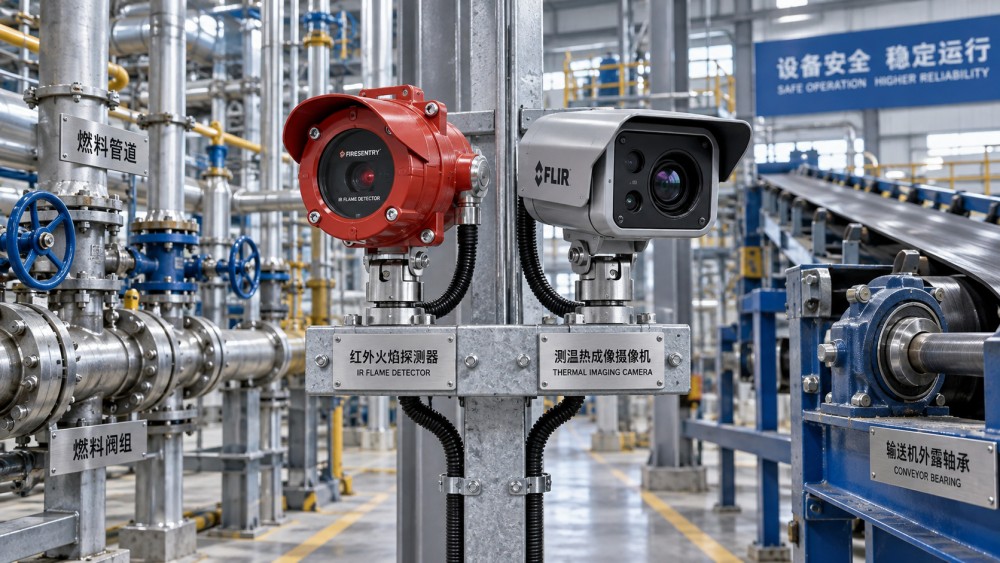
A useful coverage drawing should therefore show two different things: flame-detector sightlines to credible fire locations, and thermal-camera measurement regions on surfaces that can reveal developing faults. Drawing identical coverage cones for both technologies hides the difference between seeing a hazard and measuring it.
Where industrial conditions change the decision
In an outdoor fuel-loading area, the priority may be rapid recognition of an exposed pool or spray fire. A suitable flame detector is often the stronger primary candidate, subject to fuel-specific performance and unobstructed coverage. Thermal imaging can add situational awareness, but generic temperature analytics should not be assumed equivalent to a fire-rated detection function.
On conveyors, dryers, and material-handling equipment, the useful warning may be localized heating rather than flame. Thermal cameras can monitor accessible bearings, drive assemblies, or material surfaces. However, a hot particle hidden beneath material or a failing component behind a guard may remain invisible. Camera placement has to follow the failure mechanism, not simply the easiest mounting position.
Waste and bulk-storage applications deserve particular caution. Surface monitoring can reveal exposed hotspots, but internal self-heating may not produce a clear surface signature early enough. Changing pile geometry, moving machinery, and fresh material can also invalidate previously configured alarm regions. Where flame escalation remains credible, a complementary flame-detection layer may be justified.
Dust, steam, fog, and heavy precipitation can attenuate infrared radiation. Thermal cameras may perform better than visible cameras in some obscurants, but neither technology should be described as seeing through every industrial atmosphere. Deposits on optical windows create another shared weakness. Cleaning access, contamination monitoring, and maintenance intervals belong in the coverage design.
Nuisance alarms require separate scrutiny. Flame-detector evaluation should consider welding, hot process equipment, sunlight-related effects, and other relevant radiation sources. Camera evaluation should include legitimate hot operations, reflections, exhaust streams, and moving objects entering alarm zones. Claims of interference immunity are useful only when the test conditions resemble the installation.
Compare evidence, not attractive headline numbers
For flame detectors, request response data identifying the fuel, fire dimensions, distance, angle, sensitivity setting, and test conditions. Ask how detection performance changes toward the edge of the field of view. Optical self-tests help identify some device faults, but they do not prove that scaffolding, parked vehicles, or new pipework have not blocked the hazard.
For thermal cameras, compare measurement accuracy over the intended temperature range, lens selection, target size at maximum distance, and alarm behavior. Thermal sensitivity, often expressed as NETD, describes the ability to distinguish small temperature differences; it is not the same as absolute temperature accuracy. Higher image resolution helps only if the optics and geometry place enough pixels on the target.
Demand a clear description of persistence filters and rate-of-rise logic. Filtering can reduce nuisance alarms while also delaying a genuine alarm. In moving-material applications, a hotspot may leave the monitored region before a persistence requirement is satisfied. Acceptance testing should examine that trade-off rather than merely confirming that an alarm appears eventually.
Certification and integration determine the protection role
Relevant flame-detector evaluation frameworks include EN 54-10 and FM Approval Standard 3260, depending on the market and application. Verify the exact model, approved configuration, and scope of the supporting documentation. An approval for one product variant does not automatically extend to another lens, firmware configuration, or intended fuel.
Hazardous-area suitability is a separate assessment. Requirements associated with the IEC 60079 series, ATEX, or IECEx may apply according to jurisdiction and area classification. Explosion protection does not establish fire-detection performance. Similarly, a functional-safety claim under IEC 61508 does not by itself validate an entire safety instrumented function or its installed coverage.
A thermal camera’s industrial rating, network compatibility, or analytics capability should not be mistaken for acceptance as a primary fire detector. Where alarms initiate suppression or automatic shutdown, confirm the permitted application with the responsible engineer, insurer, and authority having jurisdiction. Evidence should cover the complete detection and control arrangement, not only the sensor.
Integration also means distinguishing fire alarms from maintenance warnings, device faults, and communication failures. Define what happens when the video server fails, the network drops, or an optical window becomes contaminated. Where a protection function needs independence from enterprise IT, local processing and supervised signal paths deserve explicit consideration.
Use complementary deployment without creating a blind spot
Combining technologies works best when each has a defined role: thermal monitoring for abnormal heating, flame detection for combustion, and visual information for incident assessment. Requiring both devices to agree before any response can be dangerous if the thermal camera cannot see the flame location or the developing event lacks a measurable surface hotspot.
Alarm voting and escalation rules should follow the hazard analysis. An advisory thermal alarm might prompt inspection, while a qualified flame alarm follows an independently engineered emergency sequence. Operator verification can support investigation, but should not silently become a prerequisite for a time-critical protective action.
Before procurement, establish acceptance criteria covering representative detection targets, credible interference sources, obscured sightlines, communication faults, and maintenance access. Use approved detector test equipment and controlled thermal targets where appropriate. Any live-fire testing requires a specifically authorized safety procedure.
Global Smart-Security & Space Intelligence (G-SSI) brings together thermal sensing, video analytics, building-system integration, and standards benchmarking. That cross-disciplinary perspective is useful here: sensor performance, alarm-path reliability, and data governance need evaluation together. Networked imagery may also require access controls, retention rules, and privacy review where identifiable personnel are captured.
A defensible infrared industrial fire detection specification identifies the event to detect, the evidence required, and the action each alarm permits. Before selecting hardware, resolve fuel compatibility, visible target geometry, certification scope, and fault behavior. Those decisions matter more than whether the proposed device has the longest advertised range or the sharpest image.
Related News
Thermal Sensing
Curation by industry experts
Popular Tags
Related Industries
- ASELSAN Says EJDERHA AD Disabled 51 Drones in a Single TestASELSAN says EJDERHA AD disabled 51 drones in seconds without missiles. Discover what the test reveals about electromagnetic counter-drone defense.
- How to prepare HVAC procurement specifications for Middle East heatMaster procurement specification preparation Middle East projects need. Learn how to compare HVAC bids, address extreme heat and define clear acceptance criteria.
- FBI Exposes FaceStealer Campaign Using Stolen Video to Bypass Face ChecksFBI exposes the FaceStealer campaign's use of stolen video to bypass facial liveness checks. Explore the risks and lessons for businesses.
Weekly Insights
Stay ahead with our curated technology reports delivered every Monday.